
Multi-Touch Attribution: A B2B Guide to Proving ROI

You launch cold email, paid social, content, retargeting, and partner outreach. A deal finally moves because someone fills out a demo form or replies to a follow-up email. Then finance asks the question every B2B marketer gets eventually: which channel drove this?
If you rely on last-click reporting, the answer is usually wrong in a very predictable way. The final branded search gets credit. The direct visit gets credit. The demo request page gets credit. The cold email that started the conversation, the content that built trust, and the follow-up touches that kept the account engaged disappear from the story.
That gap gets worse in B2B. One person gets the first email, another visits the site later, a third joins the call, and sales logs the opportunity after an offline conversation. If you’re running long sales cycles, outbound prospecting, or a pay-per-meeting model, simple attribution doesn’t just miss detail. It changes budget decisions in the wrong direction.
Beyond the Last Click An Introduction to Attribution
Teams often don’t start looking at multi-touch attribution because they love analytics. They start because their reporting keeps undervaluing the work that creates pipeline.
A common example looks like this. Marketing sends a cold email to a target account. A prospect doesn’t reply, but they visit the site later. A week after that, someone from the same company clicks a LinkedIn post. Sales follows up. Then the prospect searches the brand name, fills out a demo form, and the CRM records the conversion as direct or organic brand traffic. In a last-click model, all the credit lands on the final action.
That makes bottom-of-funnel channels look stronger than they are. It also makes top-of-funnel work harder to defend in budget reviews.
Multi-touch attribution fixes the framing. Instead of asking, “What was the last thing the buyer did?” it asks, “What sequence of touches moved this account toward revenue?” That’s a much better question for B2B demand generation, especially when your mix includes outbound, nurture, retargeting, and sales follow-up.
Salesforce’s basic logic is useful here. In a single-touch model, only one interaction receives credit. In a multi-touch model, several interactions can share value across the full path. If you want a practical example of channel-by-channel measurement in outbound programs, this overview of X DM attribution is a useful reference point for thinking beyond one-click reporting.
The business impact is straightforward. If you only measure the closer, you underinvest in the channels that create intent in the first place. That problem shows up often in performance pricing models too, where teams confuse a booked action with the sequence that produced it. The same issue comes up when companies compare meeting-based pricing with lead-based pricing. This breakdown of price-per-lead economics helps show why the definition of the conversion event matters so much.
Practical rule: If your buyer journey includes awareness, education, follow-up, and handoff, last-click reporting is a convenience metric, not a decision system.
The Core Concept From One Touch to the Full Journey
A better way to understand multi-touch attribution is to stop thinking about a conversion as a single event. Think about it as a relay race. One runner starts the motion, another keeps position, and someone else crosses the line. Crediting only the final runner misses how the team got there.

That analogy fits B2B especially well because buyer journeys aren’t linear. Marketing creates awareness. Sales development triggers interest. Content answers objections. Retargeting keeps the account warm. A meeting gets booked only after those touches reinforce each other.
A touchpoint is any recorded interaction that helps move the account forward. In practice, that can include:
-
Outbound engagement like a cold email open, click, or reply
-
Website behavior such as a landing page visit, pricing page session, or repeat return
-
Content consumption like reading a case study, guide, or webinar recap
-
Sales interactions including a booked call, follow-up email, or opportunity stage change
-
Paid media actions such as clicking a search ad or seeing a retargeting sequence before returning directly
Roivenue reports that 70% of conversion journeys involve 2 or more touchpoints in its guide to multi-touch attribution models. That’s the clearest reason last-click breaks down. If most journeys involve multiple interactions, assigning all value to one step gives you a partial record by design.
What the journey looks like in B2B
The journey isn’t just a list of touches. It’s a chain of influence. One touch creates awareness. Another validates the problem. A later interaction lowers risk enough for the buyer to take the meeting.
In B2B lead generation, it’s useful to map this journey against your funnel stages. If you already think in terms of inquiry, MQL, meeting, opportunity, and closed-won, you’re halfway there. This guide to the B2B lead generation funnel is a helpful way to align attribution with pipeline stages instead of generic traffic metrics.
Why stitched journeys matter more than isolated metrics
Open rates, click rates, and response rates each tell you something. None of them tells you enough on its own.
A prospect might ignore the first two outbound messages, visit the website from a forwarded email, come back through branded search, then convert after sales sends a calendar link. If your reporting can’t stitch those events together, you’ll optimize each channel in isolation and miss how they work as a system.
The useful question isn’t whether one touchpoint “caused” the deal by itself. It’s whether that touchpoint consistently appears in journeys that convert.
Comparing Common Multi-Touch Attribution Models
Different attribution models don’t change the underlying journey. They change the rule for assigning credit. That’s why model choice matters. You’re deciding what kind of influence you want the reporting system to emphasize.
This infographic gives the quick visual view first.
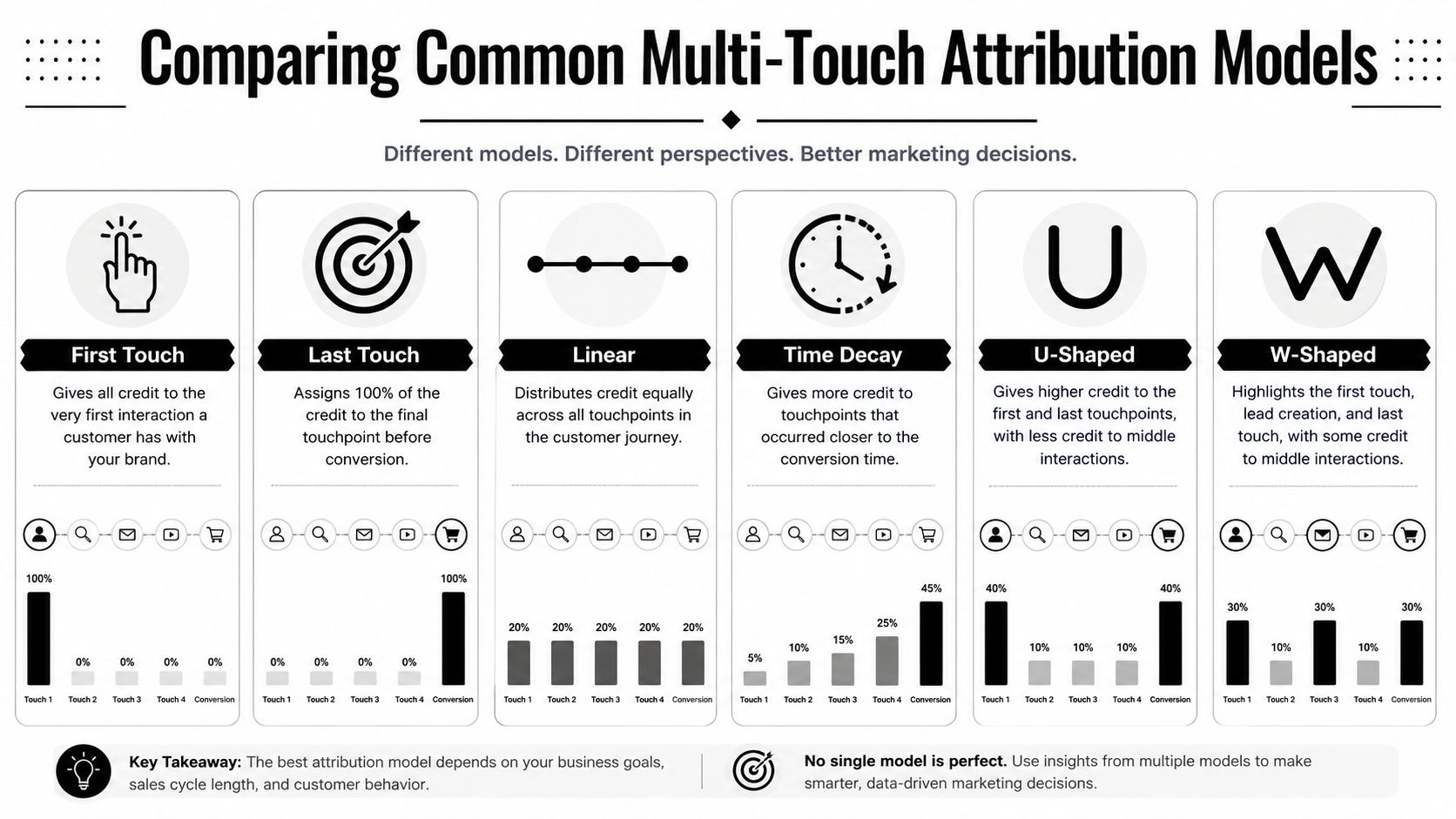
A side-by-side view of the main models
| Model | How it works | Main strength | Main weakness | Best fit in B2B |
|---|---|---|---|---|
| First touch | Gives all credit to the first interaction | Shows what starts demand | Ignores nurture and closing | Brand awareness analysis |
| Last touch | Gives all credit to the final interaction | Easy to explain | Overvalues closers | Short, simple journeys |
| Linear | Spreads credit evenly across touches | Fair and simple | Treats all touches as equally important | Teams starting with MTA |
| Time decay | Gives more weight to recent touches | Reflects momentum near conversion | Can undervalue early influence | Longer deals with active nurture |
| U-shaped or position-based | Heavily credits first and last touches | Balances awareness and conversion | Middle touches get compressed | Lead gen programs |
| W-shaped | Emphasizes first touch, lead creation, and conversion milestone | Fits B2B stage-based funnels | Needs clean stage definitions | SDR plus marketing plus sales workflows |
Salesforce describes common model structures that formalized this shift, including linear attribution, where each touchpoint can receive equal credit, and position-based attribution, where the first and last touches can each receive 40% while the middle interactions share the remaining 20%, as summarized in this Improvado article on multi-touch attribution.
What works in practice
Linear is usually the easiest starting point. If your reporting is immature, linear at least stops the organization from pretending one touch did all the work. It’s useful for revealing channels that assist often but rarely close.
Time decay fits deals where momentum matters. If a prospect goes inactive for a while and then re-engages through a focused sequence of touches before booking a meeting, time decay reflects that late-stage acceleration better than linear does.
U-shaped is often a strong option for B2B lead generation. It recognizes that the first touch matters because it opened the account, and the last touch matters because it triggered action. For many outbound and inbound programs, that’s a sensible compromise.
Here’s a short walkthrough if you want a visual explanation before choosing a model:
Where B2B teams usually go wrong
The mistake isn’t picking the “wrong” model once. The mistake is treating one model as truth.
Use the model that fits the decision you’re trying to make:
-
Budget planning may benefit from a model that values awareness.
-
Sales acceleration analysis may benefit from a model that values late-stage touches.
-
Outbound program evaluation often needs milestone-based weighting, not equal weighting.
Field note: If your sales motion includes SDR outreach, content nurture, and AE follow-up, compare at least two models before moving budget. One model rarely captures every role in the journey well.
For complex B2B cycles, a custom W-shaped or full-path setup often becomes more practical than generic first-touch or last-touch reporting.
The Data Foundation for Accurate Attribution
Most attribution problems aren’t model problems. They’re data capture problems.
If the tracking is incomplete, the model will still produce a clean-looking answer. It just won’t be a trustworthy one. That’s why multi-touch attribution works best when teams treat it as infrastructure, not just reporting.
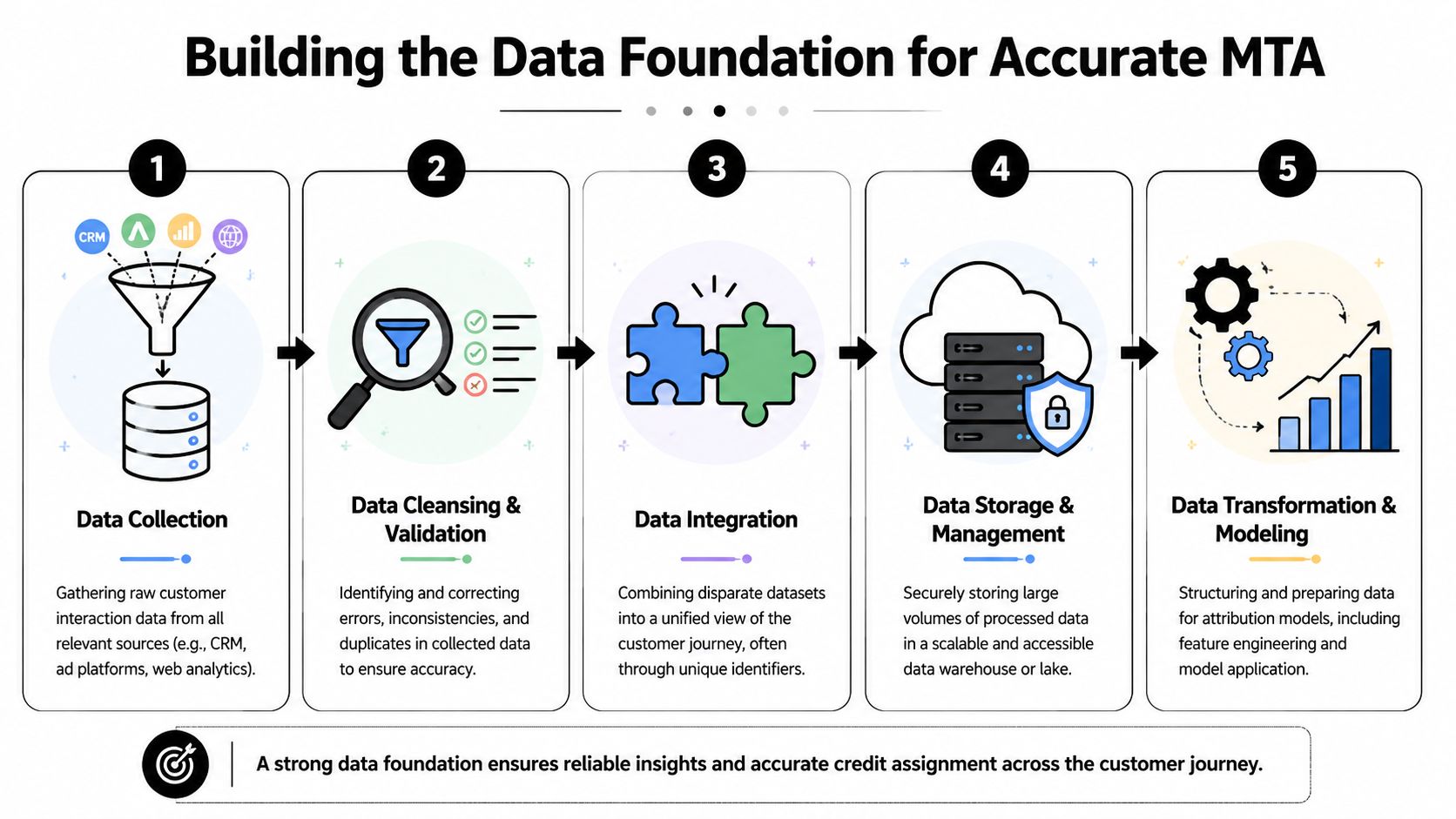
Twilio frames this well in its introduction to attribution. Multi-touch attribution is strongest when you collect event-level signals from every touchpoint, normalize them into a common identity graph, and then apply an attribution rule across the journey. In practice, that usually means combining JavaScript event tracking, UTM-tagged links, and CRM/API integrations, as explained in this Twilio resource on multi-touch attribution.
The three tracking layers that matter most
Start with consistency, not sophistication.
-
UTM discipline Every campaign link should follow a naming system your team adheres to. If paid social uses one convention, outbound another, and partner traffic none at all, your reporting won’t classify touches reliably.
-
On-site event tracking Track the events that show commercial intent, not just pageviews. Pricing visits, demo requests, case study views, and booking actions matter more than vanity traffic metrics.
-
CRM and platform integrations Marketing data has to connect to pipeline data. If meeting booked, opportunity created, and closed-won events live only in the CRM, your attribution layer needs them.
What clean implementation looks like
A practical setup usually includes:
-
Known conversion definitions so sales and marketing agree on what counts
-
Unified contact and account records to reduce duplicate identities
-
Timestamped lifecycle events that show when major funnel transitions happen
-
Bidirectional syncs between ad platforms, automation tools, and the CRM
If your CRM isn’t connected properly, attribution will break exactly where B2B teams need it most. This overview of CRM integration basics is a solid reference if you’re tightening that connection.
Bad attribution usually doesn’t come from bad intent. It comes from one broken handoff between campaign tracking, identity stitching, and CRM stage data.
Implementing MTA for B2B Cold Email Campaigns
Cold email attribution gets messy fast because the person who receives the first message often isn’t the person who books the meeting. In many accounts, that first contact forwards the message internally, mentions it in Slack, or triggers branded research that happens under someone else’s name or device.
That’s why user-level attribution alone isn’t enough for outbound. B2B teams need an account-aware approach.
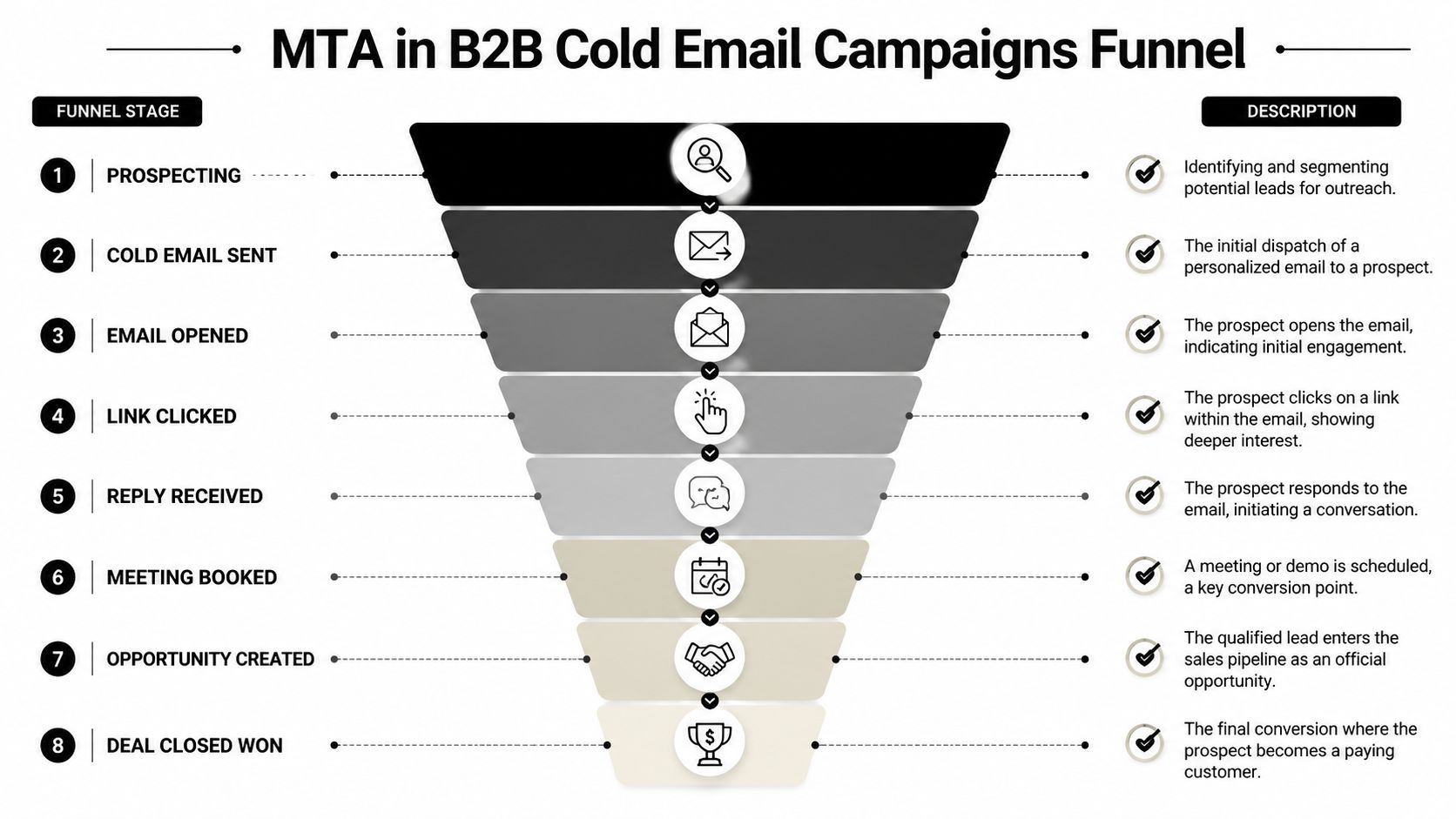
Salesforce points to a major gap in most attribution advice. Public explainers usually describe MTA at the user or lead level, but rarely explain how to handle multiple stakeholders, long sales cycles, and offline handoffs between marketing and sales in B2B. That’s exactly where cold email programs live, as noted in Salesforce’s guide to multi-touch attribution for marketing.
A workable account-level framework
Treat the account as the unit of analysis, then attach person-level touches underneath it.
A practical flow looks like this:
-
Start with account IDs Every target contact should map to a company record before the campaign begins. Don’t wait until someone books a meeting to decide how records connect.
-
Log outbound touches as real events Sent, opened, clicked, replied, and bounced each matter differently. Even when opens are noisy, sent and clicked events still help define the sequence.
-
Capture landing-page behavior If the cold email links to a page with UTM parameters, preserve source and campaign data when someone converts later through a form or booking tool.
-
Watch for domain-level matching If a visitor later identifies themselves with the same company domain, connect that known contact back to the earlier account activity.
-
Bring sales touches into the same timeline Calendar booking, discovery completed, disqualified, recycled, and opportunity created should sit in the same journey view.
A realistic cold email journey
One outbound rep emails an operations manager. The manager doesn’t reply but forwards the message to a director. The director visits the site directly the next day, reads a service page, and leaves. A week later, an analyst from the same company searches the brand, downloads a resource, and sales follows up. The director books a meeting after an AE sends a custom note.
Last-click says the meeting came from direct or branded search. A useful multi-touch setup says the account journey started in outbound, gained confidence through site engagement, and converted after sales follow-up.
That distinction matters because it changes how you evaluate channel ROI. It also changes how you staff the motion. You’re no longer asking whether cold email “closed” the deal. You’re asking whether it reliably starts journeys that produce qualified pipeline.
Operational details teams often miss
Cold email attribution improves when you tighten process around execution:
-
Sequence governance matters because inconsistent copy and CTA paths create messy data.
-
Booking-source hygiene matters because meetings booked through calendars, forms, and rep emails need a shared conversion taxonomy.
-
Deliverability tracking matters because poor inbox placement can distort campaign influence before attribution even starts.
If you’re building the operational side of outbound, these resources on mastering email automation and email deliverability services are useful complements to attribution work.
Outbound attribution gets better when marketing, SDRs, and AEs agree on the same timeline. It gets worse when each team keeps its own version of the account story.
Designing Attribution for Pay-Per-Meeting Models
In a pay-per-meeting model, the wrong attribution setup can create the wrong incentives.
If you measure everything against closed revenue alone, you won’t get timely feedback. If you measure against every booked call, you’ll reward low-quality meetings that waste sales time. The event that matters is neither too early nor too late. It’s the qualified meeting booked milestone.
That’s the conversion you should anchor the model around.
Why qualified meeting should be the primary conversion
A booked meeting is an activity. A qualified meeting is a validated commercial outcome.
For performance-driven B2B programs, that’s the point where a prospect has met agreed criteria and entered the pipeline in a meaningful way. It gives the marketing team a measurable target and gives the sales team a quality threshold. It also creates faster optimization loops than waiting for revenue outcomes that may take months.
A useful setup usually separates these events:
-
Meeting booked means a calendar event exists.
-
Meeting qualified means the account, role, need, or fit meets agreed standards.
-
Opportunity created means sales has accepted it into pipeline.
If those definitions blur together, attribution will look better on paper than it is in reality.
How to weight the journey
For pay-per-meeting programs, a milestone-based model often works better than generic last-touch. The key is to emphasize the moments that reflect real progression.
A practical custom framework can give heavier weight to:
-
The first touch that opened the account
-
The lead creation or engaged-contact moment that showed clear interest
-
The qualified meeting event that satisfied the performance objective
Middle touches still matter, but they should support the model, not overwhelm it. This approach is especially useful when multiple outbound and inbound interactions happen before a sales-accepted meeting.
What this changes operationally
When you optimize for qualified meetings, several decisions become clearer. You stop rewarding channels that drive volume without fit. You can compare outreach sources based on downstream meeting quality, not just booking count. And you can align attribution reports with the actual handoff points in your sales process flowchart.
The main discipline is governance. Sales has to mark qualification status consistently. Marketing has to preserve source data. Leadership has to accept that the primary conversion event in this model isn’t revenue yet. It’s the point where the meeting becomes commercially credible.
Tools Challenges and the Future of Attribution
The available tooling generally falls into three categories. You can use native analytics and CRM reporting, buy a dedicated attribution platform, or build a warehouse-based approach with your own data model. The right choice depends less on brand preference and more on whether your team can govern identity, events, and lifecycle stages consistently.
The bigger issue is that even good tooling doesn’t solve privacy loss by itself. Measured argues that MTA depends on reliable user-level data, but that data is becoming more incomplete because of privacy regulations and platform limits. That’s one reason many teams are moving toward blended measurement instead of treating MTA as a single source of truth, as discussed in Measured’s article on the dangers of multi-touch attribution.
What to trust and what not to trust
Use multi-touch attribution as a directional operating system, not a courtroom exhibit.
Trust it most when you have:
-
Strong first-party data capture across web, CRM, and outbound systems
-
Clear event definitions for meetings, opportunities, and revenue stages
-
Stable naming conventions so channels and campaigns classify cleanly
Trust it less when identity stitching is weak, offline activity is missing, or major platforms block too much user-level visibility.
The practical future for B2B teams
The future isn’t “perfect attribution.” It’s combining methods without pretending one dashboard can settle every argument.
A sensible stack often includes MTA for tactical optimization, CRM stage reporting for pipeline accountability, and broader business analysis for budget decisions. If you’re exploring analytical workflows around reporting and interpretation, this resource on discover AI statistics with GPT for Work is useful for teams that want help making sense of complex performance data.
The teams that get the most value from attribution aren’t chasing flawless certainty. They’re using a governed system to make better budget calls, improve channel coordination, and prove why top-of-funnel work deserves credit in long B2B sales cycles.
If you want a B2B lead generation partner that aligns with outcomes instead of retainers, Fypion Marketing specializes in cold email outreach and pay-per-meeting engagement models built around qualified pipeline, not vanity metrics.